Showing posts with label wetlands. Show all posts

Sunday, May 13, 2018

Boblink, Life Bird #2, Duck River Unit


The Duck River Unit of the Tennessee National Wildlife Refuge is a huge haven for birds who love grasslands, reeds and endless fields of wildflowers. Yesterday, I captured this beauty along the side of the road where the grasses were a tad taller. As I neared him, he would fly off obviously. He was accompanied by four or five other Bobolinks. This is a second life bird in one day for me!

Sorry for the very cropped image and horrific background, but I had to share as this Bobolink's markings are so unique. A yellow backed head and white wings. I read Bobolinks breed in the north central and north east areas of the United States. They migrate to the Southern states. The Duck River Unit would be a perfect habitat for them to breed. No doubt why they chose to stop over here. When I can't identify a bird in the field, I snap images and crop tightly in my software to identify them. This was the only descent image worth posting and I only post it as it's a life bird. I couldn't help myself. My bird life list is growing. It's a scorcher today if you are in the Midwest and especially the South in the States, so hydrate. ENJOY!

Friday, May 11, 2018

Dickcissel, Duck River, TN National Wildlife Refuge


Say hello to the Dickcissel. He is a life bird for me. I hadn't anticipated finding a new species today on my visit to the wildlife refuge. I visited the Duck River Unit of the Tennessee National Wildlife Refuge today. This little bird kept flying from stalk to stalk. When he got close enough, I stopped to snap these images. All the while I sat and snapped away he sang to me a beautiful song.


Dickcissels migrate from the Deep South north and and generally breed in the Midwest. With the many grasslands in the Duck River Unit, I venture to guess this little fella could make this his home. Many of the roads were closed for the season, in late 2016 when I last visited here, but they were open today, so I was able to drive deep into the refuge.


I encountered many species of birds today including Great Blue Herons, Great White Egrets and Cormorants. I'm fairly certain I even caught a glimpse of a Yellow Headed Blackbird before he flew away.

We are in the throws of a heat wave here in Tennessee and the South. The next three days will be sweltering and will no doubt reach the 90's. I had planned to travel to Gibbs Gardens this weekend in northern Georgia. I opted out of that trip as the heat wave isn't conducive for walking two or three hours in the hot sun taking in the gardens. Perhaps it will cool off in a few weeks and I can get there. Stay cool out there. ENJOY!

Thursday, July 20, 2017

Dragonfly Snaps


After my Sunflower photo session, I drove to Murfree Springs Wetlands in Murfreesboro. In spite of harsh light and heat, I walked around the boardwalk. Not much was stirring except an abundance of Dragonflies. I 'think' this is a Blue Dasher resting on a plant near the edge of the boardwalk. His wings are so beautiful glistening in the sunlight.


I eyed the edge of the boardwalk and spotted what I believe is an Eastern Pondhawk perched on a plant. I am not an expert when it comes to Dragonflies, but I do enjoy photographing them. I thought I would share one of the explanations I found for the origin of how the Dragonfly got it's name.

In old Romanian folklore, the dragonfly was actually a horse ridden by Saint George. St. George rid the mythical town of Silence of the dragon that lived in the town’s pond and poisoned the town. After wounding the dragon, he leashed the dragon and gave it to the town’s princess. Saint George’s horse became a giant flying insect when cursed by the devil. In the Romanian language, the word for dragonfly translates into Devil’s Horse or Devil’s fly. The Romanian word for devil is drac, which can also indicate dragon. In English, it translated to dragonfly.

The weekend is upon us and with yet more days of high heat and humidity. Today was 97 and I'm sure the heat index was in triple digits. There's no relief in sight either. Am I allowed to say I'm almost ready for Fall. Did I actually say that? Oops. Stay cool all. ENJOY!

Monday, April 18, 2016

Bird Behavior

This was the perfect weekend to visit Murfree Spring Wetlands. Blue skies, bright sunshine, no humidity. I usually walk along the boardwalk shifting from one side of the walkway to the other while scouring the swamp for any sign of movement.


What I wasn't expecting was to find a Yellow Crowned Night Heron fishing in the middle of the swamp in the back of the wetland. He was very intent on the task at hand and didn't mind one bit that I stood on the boardwalk and took photos. He would stand straight up, then lean over. Then he would lift up one foot and take a step. Then he would lift up another and drop it. Then ..... pounce!


He was in and out of the water so fast, I couldn't even get a decent image. Yet, there he was hanging on to a crayfish.


Gotta get this crayfish in just the right position so he can swallow it, no doubt whole.


After several catches, the Heron decides its high time for a preening session which included some 'under the hood' work. Amazing. If I didn't know better I would swear he was trying to play hike and seek with me. Hope you had a great weekend. ENJOY!

Saturday, May 30, 2015

Green Frog, Murfree Spring Wetlands

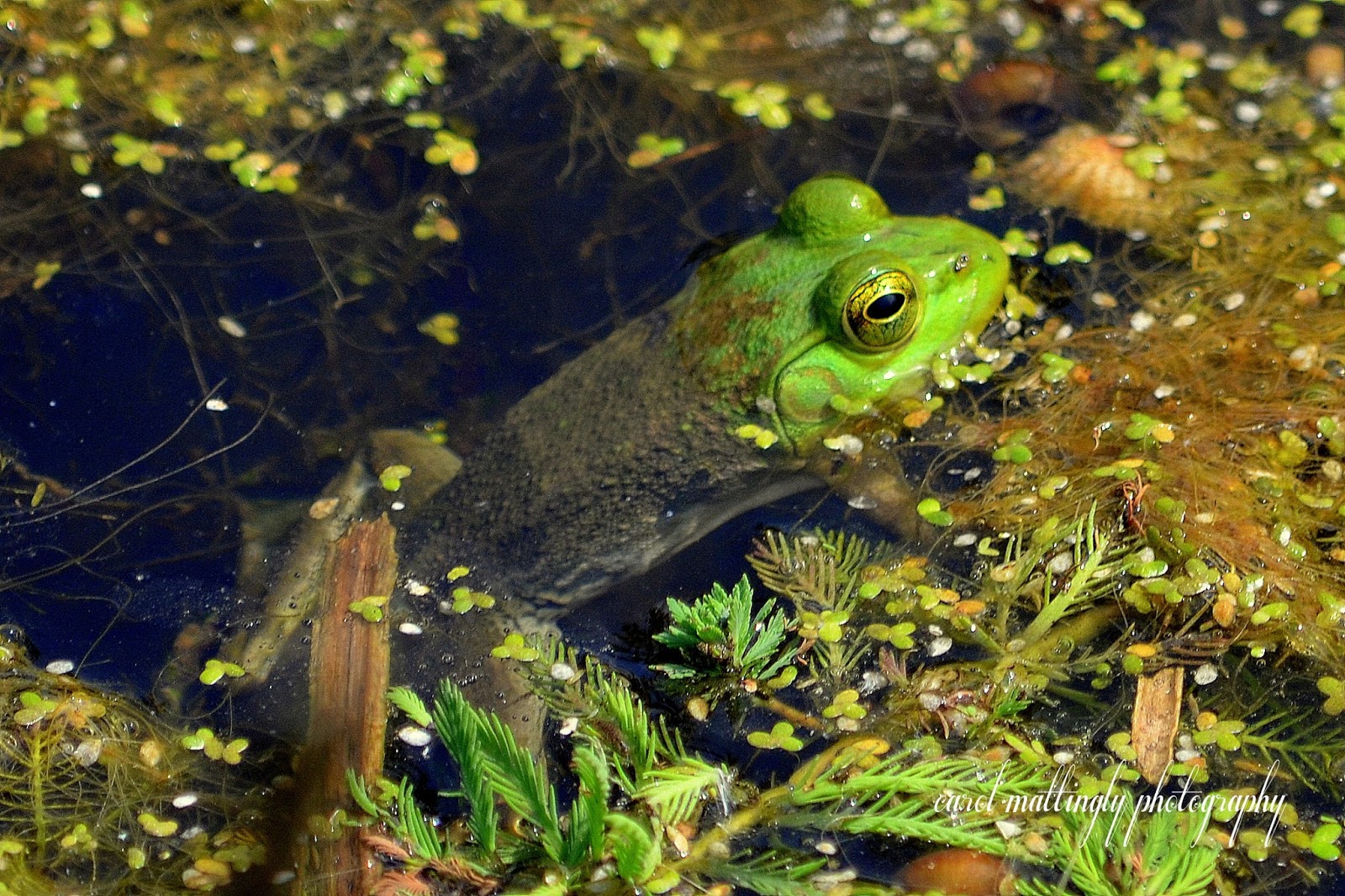
At Murfree Spring Wetlands I happened upon large and small birds, mammals, amphibians and a plethora of marshes, swamps and more pond weeds than I had ever seen in my lifetime. While reading up on Green Frogs, I discovered that pond weeds are also referred to as duck weeds.


Mid way into my first walk, half way back into the wetland, this Green Frog stuck his head up out of the water in a less saturated pond weed area. This little guy is in the perfect habitat what with all of the insects one can find hanging out in the wetland. I discovered upon reading about Green Frogs that this is gal, a female Green Frog. Females have a similar size tympanum, external hearing structure, just behind the eye. The tympanum actually transmits sounds to the inner ear. Males have a much larger tympanum which is the perfect distinguishing characteristic.


At the end of my wetland walk, I lingered to look over the boardwalk into the swamp and up popped another female Green Frog. This gal was almost totally camouflaged by heavy pond weeds. She sat on top of the water while I captured a few images of her.

I plan to venture back to Murfree Spring Wetland often in the near future in hopes of seeing the Beavers and River Otters that reside there. I encountered considerable evidence of the Beavers all along the first half of the boardwalk. Near the back of the wetland sat a very large Beaver lodge out in the swamp. Everyone have a fantastic weekend. Stay dry as there is quite a bit of rain forecast for the midwest, south and eastern United States. ENJOY!

Linking to Saturday Critters

Thursday, May 28, 2015

Eastern Phoebe


At Murfree Spring Wetlands I attempted to capture photos of the woodland birds flitting about on the dead branches spread throughout the swamps and marshes. This little bird is an Eastern Phoebe. One of the most familiar of the eastern flycatchers. Phoebes are quite hardy and have a stocky physique and are generally brown and white. If only he would have had a fly or gnat in his beak that would have made for a better image, but I will take what I can get.


Eastern Phoebes generally perch on low hanging branches or low in trees. They form mud-and-grass nests attached to bridges, barns and houses. I can honestly say I have never seen an Eastern Phoebe nest. Eastern Phoebes migrate north and are one of the first birds to migrate back to the south each year. This is a Life List Bird for me. ENJOY!

A SPECIAL NOTE TO MY FAITHFUL FOLLOWERS
Since moving here to Tennessee I have encountered quite a few birds to add to my Life List.
The list is posted on this blog in the right column mid way down if you would like to see just what species of birds
I have encountered throughout my journeys. Thank you for stopping by my blog
and thank you for all of your wonderful comments. I read every single one and cherish all of them.

Since mid December I have at least 25 new followers to my blog from all over the globe. 
I want to thank each and every one of you for following my posts and if you haven't left me
a note or a comment, I hope you will soon. I love to hear your thoughts on my outings to capture
images of our beautiful planet. I translate any comments that aren't in English. 
So never fear, I'm reading your comments no matter the language. Thank you for following!

Tuesday, May 26, 2015

Yellow Crowned Night Heron


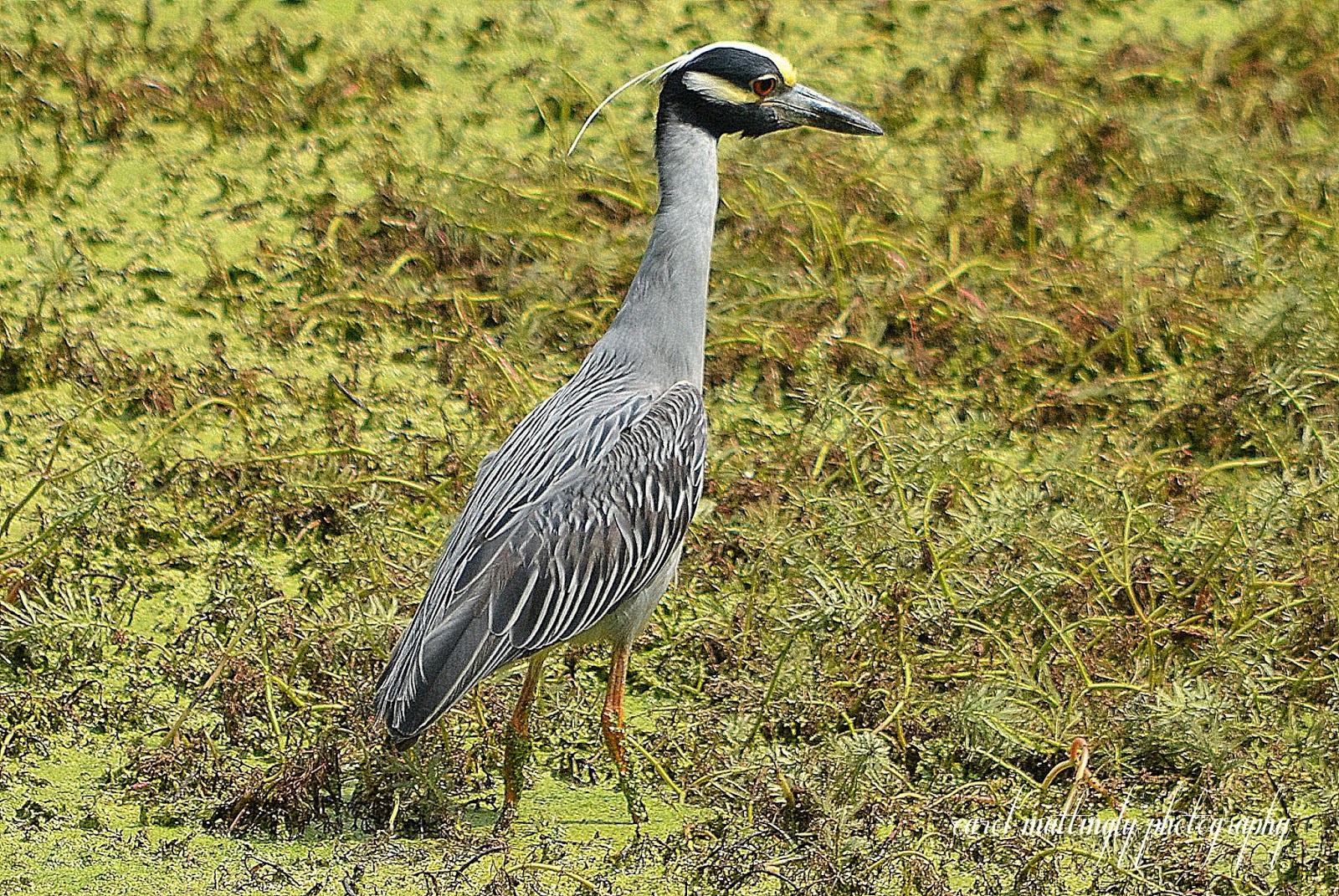
As I was about to end my walk around Murfree Spring Wetlands Sunday, I turned the corner toward the entrance and saw this beautiful creature standing in the middle of the large swamp. This is a Yellow Crowned Night Heron and a Life List bird for me. Isn't he gorgeous. I had never laid eyes on one before. Quite honestly, I didn't even know there was such a thing. The only thing I knew for certain was this was not a Black Crowned Night Heron.


It didn't take long for me to identify this bird as I knew it was some sort of crowned Heron. Yellow Crowned Night Herons are nocturnal birds that reside mainly in southern swamps and along southern coastlines. The yellow crown is their distinctive feature which is what they are named for although they do have yellow legs as well. These Herons are stockier than the Great Blue Heron, the Little Blue Heron or the Tri-Colored Heron.


A juvenile Yellow Crowned Night Heron has a longer neck and sports a grayer toned body. Actually, the juvenile doesn't really resemble the adult all that much when I looked them up online. I thought perhaps I would see a Black Crowned Night Heron at the wetlands as I had seen photos online that mentioned sightings, but no dice.


The entire time I photographed this Heron he was very intent stalking about in search of a snack. Finally, a lady with two young boys approached and off he flew. I knew he wouldn't stay long with young children chatting away. It has rained off and on since yesterday, but hopefully we won't have the drenching rain that Texas and Oklahoma are getting. Such tragedy in Texas from the floodwaters and on Memorial Day no less. My heart goes out to everyone there. Back soon with more images from my walk on the wild side. ENJOY!

Monday, May 25, 2015

Wood Ducks, Murfree Spring Wetlands

Murfree Spring Wetlands is a remarkable place to visit and to think that it is right in the middle of a large town is even more remarkable. I decided to visit here as it called for a shorter drive than the refuge I had planned on visiting.


The iridescent green and purple of the male Wood Duck are gorgeous, not to mention its red eyes, beautiful flare down its neck and multi colored bill. Both the male and the female share crested heads. This species is akin to the Asian Mandarin Duck.


The Wood Duck or Carolina Duck is a perching Duck known throughout North America. These Ducks prefer wooded habitats such as wooded swamps which is exactly what Murfree Spring Wetlands is known for. You can find the Wood Duck female's nest in wood boxes and tree cavities.


I tried to see if I could locate where this pair of Wood Ducks may have nested, but the swamp and its marshes were so dense it was difficult.


Another remarkable thing about these Ducks is that in the eastern and western United States 75% of Wood Ducks are permanent residents. Generally, the eastern Wood Ducks use the Atlantic Flyway while the western use the Pacific if they are not permanent, but are migratory.

I wanted to mark this Memorial Day by mentioning that I think often about those who gave their lives for our country,
as my Father did having suffered from PTSD, which ended his life at the young age of 52.
My heart goes out to those of you who are and those of you who have served for our country, 
living or dead, so America can be free. As I often see and hear 'Freedom is not Free'. God Bless America!


Linking to Saturday Critters

Sunday, May 24, 2015

Muskrats, Murfree Spring Wetlands

Today was the perfect day for an outing. The temperature was in the mid eighties with an abundance of sunshine peeking through the clouds and at times a nice breeze would blow through to cool things off. I decided to visit Murfree Spring Wetlands in Murfreesboro, Tennessee, southeast of Nashville. The wetland is situated next to the Discovery Center which is a children's venue accompanied by a museum. The wetlands is about 25 acres and is home to mammals, amphibians, birds, waterfowl and obviously thousands of insects. The definition of a wetland follows . . .

Wetlands are land areas that are saturated with water, either permanently or seasonally, 
such that it takes on the characteristics of a distinct ecosystem. Wetlands include swamps, marshes
and bogs. Wetlands vary widely because of  differences in soils, topography, climate, hydrology,
water chemistry, vegetation, and other factors. Wetlands are economic drivers because of 
their key role in fishing, hunting, agriculture and recreation. 


This being my first visit I was surprised to find a large Muskrat sitting on top of marsh weeds and grasses munching on pond weeds. Pond weeds are the tiny green weeds you see in the water all around the Muskrat. This Muskrat looked to be an adult and wasn't the least bit concerned at my presence nearby on the boardwalk. So I gingerly snapped a few images of him having a midday snack. After a few minutes and having gotten his fill, he disappeared into the water never to be seen again.


After my initial walk around the parameter of the wetland, I headed back to my car for a quick drink of water. The sun was coming down pretty good at times making for a warm walk. Back to the boardwalk for a second lap around, I just happened upon several smaller Muskrat feeding on pond weeds right inside the wetland entrance. Muskrats in residential environments can be a nuisance, but these little guys were in the perfect environment in the swamps and, needless to say, there was plenty of food to be had.


My visit was packed full of sightings of all types of species from mammals to waterfowl. Along the boardwalk I happened upon large Turtles basking in the sun covered in pond weeds, Eastern Pondhawk Dragonflies, Green Frogs and, of course, the Muskrats. The birds I encountered were the Yellow Crowned Night Heron, a pair of mated Wood Ducks, a Grackle, several Eastern Kingbirds, countless Robins, and the Red Winged Blackbird which are plentiful around swamps and marshes. There was a virtual plethora of wildlife to be seen and enjoyed. I hope your Memorial Day holiday has been enjoyable and I promise I will be back in a day or two with more images from my visit. We have rain on the horizon for tomorrow. Apparently that front that has caused major flooding and storms in Texas and Oklahoma is headed my way. Although I don't think we are supposed to get quite as much rain as the Midwest has gotten. ENJOY!

Friday, October 15, 2010

The Many Colors of Fall!


A scene I photographed several weeks ago on a quick stop at Mustatatuck NWR. This tree normally sits in several feet of water but as you can see not right now due to the severe drought. The sun was low in the sky. I like the colors it cast as the sidelight bathed the tree and the water. Have a wonderful weekend everyone. ENJOY!

Tuesday, September 21, 2010

Mustatatuck NWR, Seymour, Indiana


These are a few of the images I captured while on a brief visit to Mustatatuck National Wildlife Refuge in Indiana a few weeks ago. Such a serene, peaceful place to walk and view wildlife and nature in general. Stop by sometime. It's two short miles off I-65 at the Seymour Indiana exit. You can drive the entire refuge which is great. They also have a gift shop open until late afternoon most days. I always see herons on my visit. While walking the hardwood forest path, the last image, I happened upon two does and a fawn who scurried off into the woods.

Soon the whooping cranes will be flying in for a stopover on their annual journey south to their winter home. Unfortunatley, the public doesn't get to view them while they're here. The ultralight crew takes great pains, as does Mustatatuck, to assure its all a natural journey and the public aren't around the cranes. I'll post a few more images later this week. The marshland was at the lowest levels I had ever seen on this visit. And I've seen some low marshes, but this year it was really really extreme. I hope it gets rain soon. Louisville is now under a drought notice as of a few days ago. ENJOY!

Wednesday, August 26, 2009

Mustatatuck National Wildlife Refuge, Seymour, Indiana


Sometime back I posted a barn image from Mustatatuck National Wildlife Refuge. This past Sunday on my way home from Nashville, Brown County, Indiana, I took some images of the wildlife and wetlands at the refuge. This particular visit netted a wide variety of wildlife. The wetlands water level, as is always in the summer months, is very low. It's odd but almost every time I visit here, I come away with one dominate thought. Life goes on, one season after another, wilst we are here or are away. You see this in the wildlife that flourish throughout this refuge.

These are digital images. It has to be said that my Pentax would have done a much better job of it, but nonetheless, here are the digital images I took. I give you commarants, blue heron, egrets and turtles. It's worth a visit. Enjoy!